
Search is currently unavailable. To use search functionality, please accept cookies in your preferences.
Ultra Resilience
When natural disasters hit our trails, we lose more than recreational space; we lose community. The good news is that both return.
13 min leer
Taylor McKenzie Gerlach
May 23, 2025
“If I get hurt, lost, or die,” the race director starts as a group of just under 100 runners repeats the refrain shouting in unison, “it’s my own damn fault.”
I’m at the starting line of the Nine Trails Endurance Run in Santa Barbara. The half version of the run—by definition explicitly not a race, as I’ve been reminded by organizer Luis Escobar—will be my first organized trail run with an entrance fee, aid stations, and official results. It may be my first time shuttling up to the Jesusita Trailhead above the morning light glinting off the Pacific Ocean below, but Nine Trails alums have been doing this for decades.
The 35-mile endurance run first started in 1990 when a Santa Barbara local looked for a new challenge: could she link up nine of the city’s trail systems to craft an epic, challenging run? Patsy Dorsey spearheaded the effort, mapping a route that attracted a handful of curious trail runners, Escobar included. “It was just this small, funky thing; thirty people showed up, and it was non permitted, completely under the radar, totally illegal” Escobar remembers, “which was kind of the fun of it at the time.” Since then, the funky little thing has transformed into an iconic Southern California event known for a tough course ripe with technical trails and big climbs. Escobar took over management in 2004, securing Forest Service permits and watching signups swell to about 300 runners annually, still deeming the race a small, intimate endeavor in the world of ultrarunning.

This year is special, though, as 2025 marks the run’s comeback after a three-year hiatus due erosion from fires, floods, and storms that severely damaged the trail systems. Some sections were left beyond recognition. Escobar remembers when a quick hop would clear San Ysidro Creek along the Nine Trails route; now, erosion has transformed the once-tiny landmark into a rocky, 50-yard-wide expanse. This most recent postponement wasn’t the race’s first brush with natural disaster; the 2017 Thomas Fire damaged a handful of the trails, and the race has been moved or cancelled a few times throughout its history.
It’s no secret that natural disasters affect outdoor recreation. Living and recreating on the West Coast, I’ve grown accustomed to checking fire forecasts and smoke levels before planning a trail run or backpacking route. An attempt to circumnavigate Mount Hood last summer ended before it started when we awoke to howling winds and heavy smoke from a nearby wildfire; the same year, I postponed mountaineering plans along the North Cascades’ Ptarmigan Traverse due to a fire. It’s becoming increasingly uncommon to finish the Pacific Crest Trail uninterrupted by a fire, or subsequent debris flow and erosion. Detours and itinerary swaps are an essential part of outdoor recreation as users respond to natural disasters.
Along with the landscapes affected by disaster, the communities built around outdoor spaces and activities suffer. Recreational trail systems, especially urban-adjacent trails like those of Nine Trails located just miles from downtown Santa Barbara, are central to building community among large swaths of outdoor folks; when they get hit by disasters, the community does as well.
The good news? Landscapes do recover, and the community events they inspire return. Having completed the Nine Trails run 22 consecutive times, Escobar has seen the transformation with his own eyes. Sure, the burn scars are obvious in the direct aftermath of a fire. Plant life is fully destroyed, and the scene looks hopeless. But a handful of years later, he’s seen foliage come back even stronger and more lush than before.

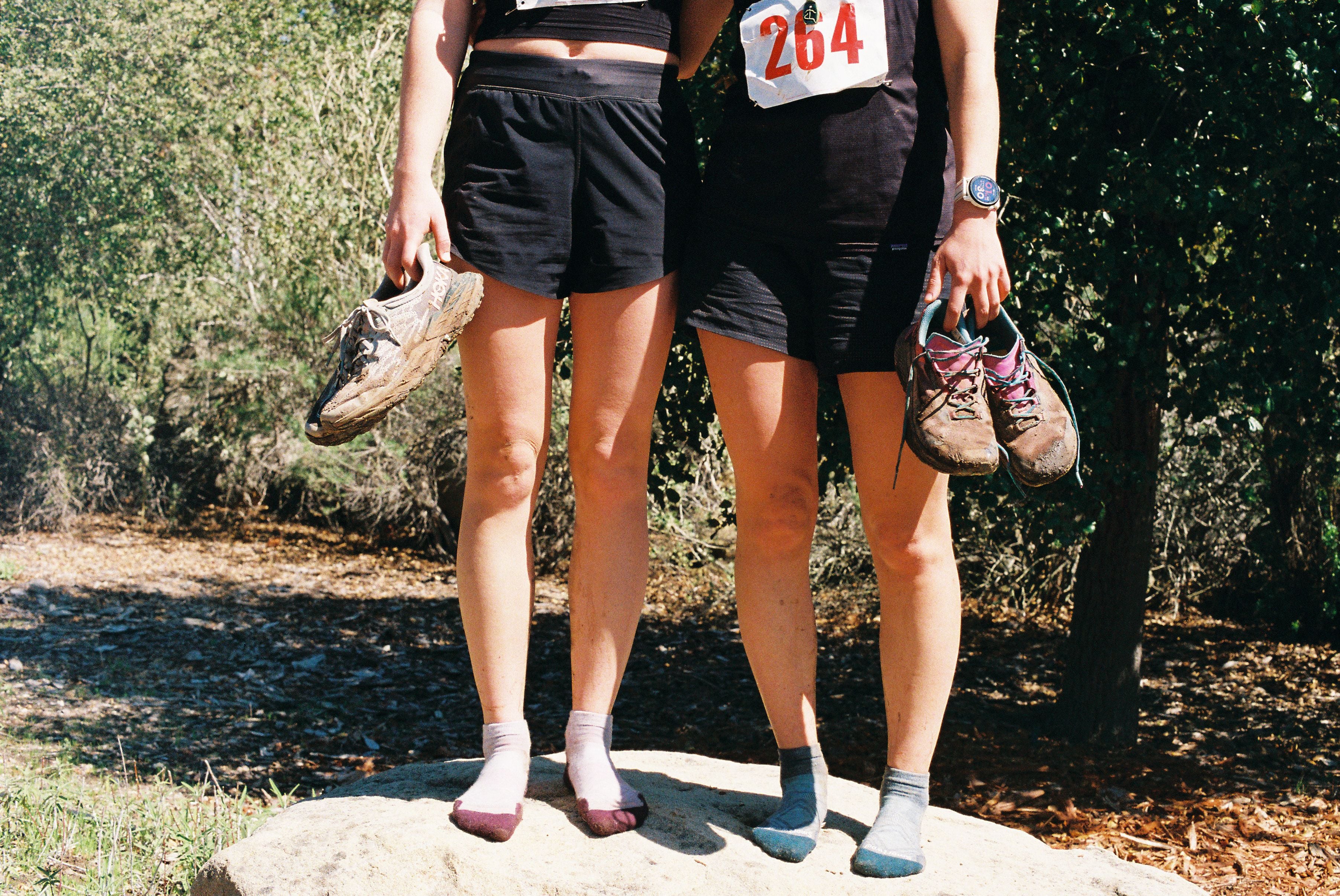
Did I pack a film camera for the run? Yes I did.
The trail systems and the race have somewhat of a symbiotic relationship, Escobar explains. Getting local people out to experience these stunning trail systems is one of his main aims with Nine Trails, and he hopes that their experience will inspire action and protection.
“There's a personal benefit, but there's a benefit to the trail system itself,” Escobar explains. When more people use the trail, more people will feel ownership and responsibility to care for the landscape, he hopes. It helps that most of the Nine Trails runners are local folks who will train along the same mountains and rivers the course traverses, inspiring even more of a sense of concern over the trails’ wellbeing.
“I think the more time they spend out there, the more apt they are to contribute time and resources to trail restoration and maintenance.”
At the starting line of the Nine Trails Half—a 17-ish-mile course that follows half of the full 35-mile classic route—trail restoration work and Escobar’s permit negotiation is paying off. The environment has recovered, the route has been ground proofed for safety of the runners and the trails, and the iconic, community-forward run is finally back.
As we start running up a paved road and turn left to dip into the first trail, the strong community vibes are apparent. I squish through mud, laughing to strangers running alongside me, and patiently pick my way across rocky streams, following the footsteps of the runners before me.
In many ways, the race retains its DIY, anti-establishment roots. This isn’t Big Running, and it deviates from the norms of other ultras. Spectators? Not allowed. Crew? Don’t even think about it. A pre-run Zoom meeting informed us that aid stations would be “minimal but adequate.” Even as the run has grown, it still feels like a bunch of friends enjoying their hometown mountains. “Should we follow this odd out-and-back in the official Strava route?” someone asked in the meeting. The answer: Nope, that was the course manager heading into the bushes for a bathroom break. Definitely don’t follow that.

Without spectators along the route, the other runners are my only community for the next several hours. I run with a friend for a bit before she pulls ahead on a steep hill. I’ll run into her at the aid stations, making for a fun surprise every few miles between quad-burning hills and sweeping vistas. When I pass other runners, we pause to chit chat about the views, or our tired legs. The aid stations, where the friendly faces of crew members would typically be waiting on other ultras, are populated with high-energy volunteers who kindly offer to fill my water flasks and hand over Oreos. They record our bib numbers by hand, eschewing the RFID chip tracking that’s become a modern race mainstay. Saying “578” aloud to a human with a pen and paper has a personal feel, like I’m staking claim on the accomplishment of making it to each aid station.
By mile 10, I’ve grown accustomed to spotting the pink flagging tape marking our route through dense forests with winding creeks, rocky, desert-like expanses without shade, and muddy clay trails lined with wiry trees. Retracing my steps for the last few miles of the out-and-back route, I pause on top of Inspiration Point’s precipice to spy the city and ocean below, runners’ packs weaving through the foliage, and the sage green mountain ridges just beyond the next valley. My ankles are tired from navigating rocks as I let gravity carry me downhill at a terrifying clip, and my quads resist every time the never-flat trail climbs upwards again.
In the sections muddied by spring rains, I can see how the usually-dusty traverses would be slippery and difficult for runners, and how the trails would struggle to recover from heavy rains, debris flow, and strong storms.
Continuing past the final creek crossing, I trend uphill to the sounds of cowbells and whoops. I cross the finish line with two Nine Trails traditions, a hug from founder Patsy Dorsey and a hand-crafted amulet placed around my neck before I limp towards a shady place to collapse.
Cheering as others cross the finish line, I’m buoyed with hope. Clearly, unbridled stoke and community around outdoor activities does return from any disaster-created hiatus, just as the environment heals itself.

During race preparations, Escobar shared some ways recreationalists can support the environments they care about, helping them recover from disaster and stay strong so that community events can return.
1. Be empathetic to all stakeholders.
Often, people who live near popular recreational areas have concerns over use and safety. “Be as compassionate and respectful as you can for the people that live in those communities,” Escobar advises. For example, the folks that live near the trail systems Nine Trails traverses are very concerned about fire hazards; this fear sometimes translates into conflict about how people recreate next to their literal backyards. For the Nine Trails run, no parking was allowed on the road leading to the start in an effort to keep the road clear for emergency vehicles and assuage a legitimate fear held by nearby neighbors.
2. Think about the bigger picture.
If a race gets cancelled, postponed, or moved, Escobar wants runners to know that race managers like himself are acting in the best interest of everyone involved. “It's not just about a race. It's not just about you getting a t-shirt or getting a medal. It's about the community working together to try to create something that's good and safe and beneficial to everyone involved.” Permitted events require buy-in from neighbors, the Forest Service, county parks, state parks, and race management.
3. Respect trail closures.
Simply put, don’t be selfish. Trails closures are determined for a reason, and use of the trails before they have recovered will delay their return. Act in the best interest of all users and respect closed signs and no trespassing signs so that trails can reopen for all to enjoy.
Video player
Cargando...
Mi cesta
Your Cart ()
No tienes ningún artículo en tu carrito.
You may also like
Subtotal:
Subtotal after discount:
Cargando...